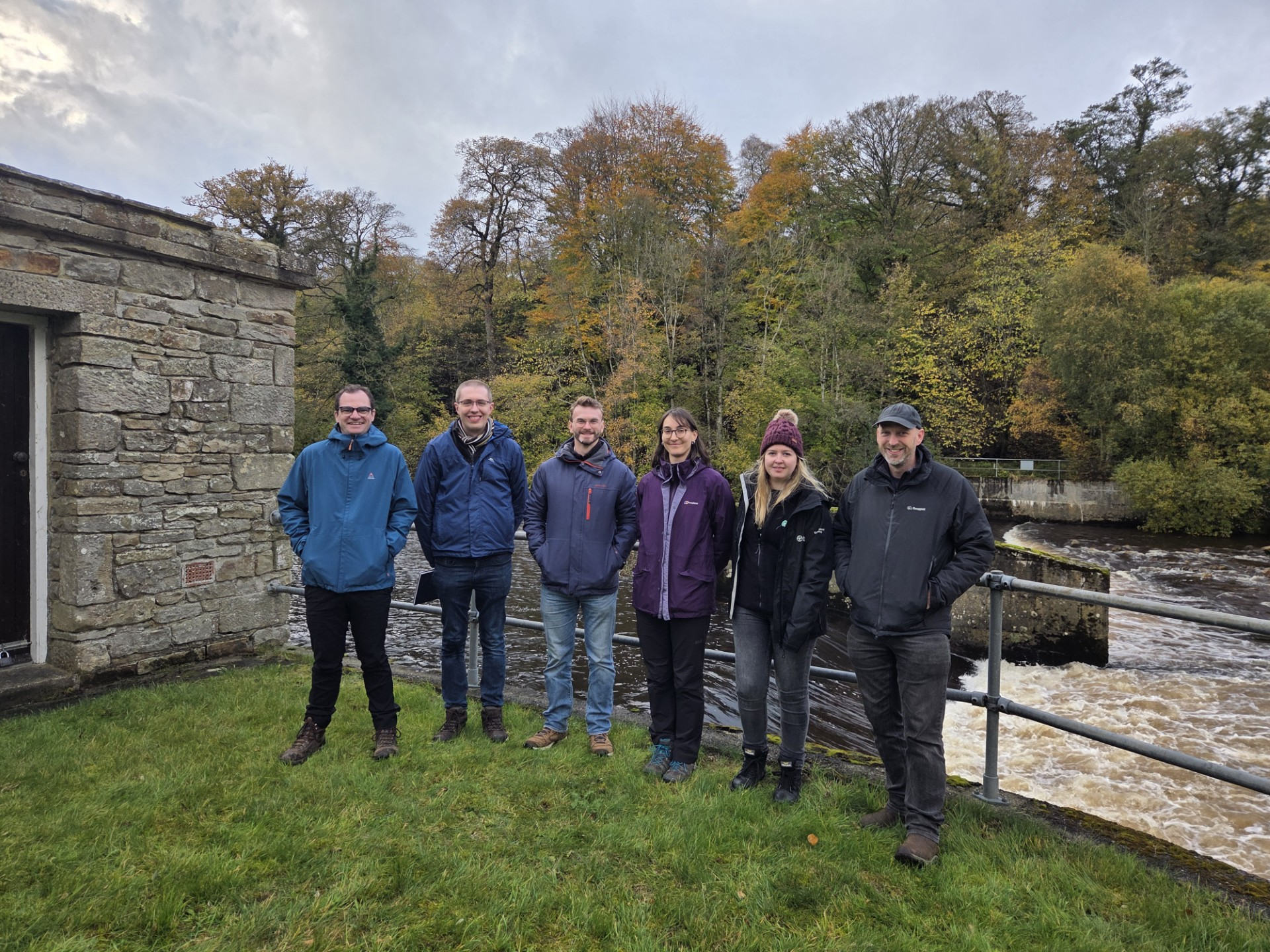
National River Flow Archive (NRFA) staff Steve Turner and David Crowhurst, and the NRFA North East regional representative, Nathan Missault, carried out a two-day liaison visit to the Environment Agency North East region on 28-29 October 2026. Also in attendance was Tom Gribbin from the British Geological Survey (BGS).
The liaison visit provided an opportunity for the NRFA and BGS to meet Environment Agency staff responsible for the region's river and groundwater monitoring networks, discuss current activities and share knowledge. Site visits were also made to gauging stations and boreholes across the region. The knowledge gained during liaison visits helps the NRFA to maintain and improve its metadata holdings, ensuring that users have access to up-to-date contextual information necessary for accurately interpreting and analysing river flow data.
The first day began with an office meeting at the Environment Agency office in Newcastle, and was followed by visits to gauging stations in Northumberland and the Northern Pennines. We visited the South Tyne at Alston (23009), where we discussed operational challenges associated with using cableways for high flow gaugings, and the South Tyne at Featherstone (23006), which features a compound Crump weir where gravel build-up can be an ongoing issue. We then travelled to the Tyne at Bywell (23001), a National Hydrological Monitoring Programme (NHMP) site, where we learned about the impacts of Storm Desmond in December 2015. A check gauging here recorded a flow of 1267 cumecs, which was believed to be the highest flow ever measured in person at a UK gauging station at the time.
On the second day, we travelled south, visiting the Wear at Chester-le-Street (24009), the Wear at Sunderland Bridge (24001) and a nearby groundwater borehole. Discussions focused on the influence of minewater discharge on the River Wear, which can make a significant contribution to flows during dry weather. We then continued to Darlington for stops at the Tees at Darlington Broken Scar (25001), the Skerne at Darlington South Park (25004) and a further groundwater borehole. Discussions focused on fish passes and the challenge of balancing ecological improvements with the need to maintain accurate flow measurements.
Thank you to the Environment Agency North East Hydrology and H&T teams who hosted our visit. The NRFA is grateful for the effort made to share valuable knowledge and insights, helping to support the ongoing maintenance and improvement of the archive.